How to exercise at home for health benefits
Many people put off keeping fit because they don’t have a gym membership. There is a widespread belief that a strong body and a healthy heart can only be achieved amongst heavy exercise machines and metal barbells. However, the human body is governed by the universal laws of biology. Muscles and blood vessels respond not to the walls of a gym, but to actual physical exertion, heart rate and the regularity of exercise.
The World Health Organisation does not equate physical activity with gyms. WHO experts view movement as a natural part of everyday life. For a healthy adult, it is sufficient to accumulate between 150 and 300 minutes of moderate aerobic activity per week, or between 75 and 150 minutes of more intense exercise. Doctors recommend adding simple muscle-strengthening exercises to this at least twice a week. A room at home, a flight of stairs in the block of flats or a path in the park are enough to meet these guidelines without buying a gym membership.
How muscles recognise exertion without weights
Muscle fibres are designed very practically. A muscle fibre cannot distinguish the source of resistance. It makes no difference to the muscle what causes the tension: an expensive barbell from the gym or the force of gravity during a standard push-up.
To trigger an increase in strength and muscle density, the body needs just two conditions.
Firstly, the muscle must experience significant mechanical tension. The load must force the nervous system to recruit more muscle fibres.
Secondly, the load must increase gradually over time. In sports science, this is known as the principle of progressive overload. The tissues need a constant, gentle challenge to keep them adapting.
At the gym, you simply add extra metal discs to the barbell. At home, using your own body weight, you alter the laws of leverage and angles of inclination. Over time, standard squats give way to lunges, then to Bulgarian split squats with the back leg resting on a chair, and later to single-leg squats. The muscles receive exactly the same powerful stimulus to strengthen, but the joints do not experience any excessive compressive pressure.
What scientific research confirms
The effectiveness of home workouts has been studied in medicine for many decades. Scientific data clearly distinguishes between proven physiological facts and preliminary observations.
Established facts of physiology
Clinical trials confirm the basic principles of how the body works:
- Cardiovascular endurance develops very well without gym equipment. Brisk walking in the fresh air, climbing stairs, running and skipping strengthen the heart muscle and improve the elasticity of the arteries just as effectively as treadmills.
- Bodyweight exercises reliably increase the cells’ sensitivity to insulin. This reduces the risk of developing type 2 diabetes and improves lipid metabolism, regardless of where you exercise.
- Bone density increases in response to dynamic movement. Home exercises involving moderate impact protect the skeleton from age-related fragility.
Conclusions from meta-analyses and comparative studies
In 2026, a major systematic review of fifteen controlled studies on home interval training was published. Researchers found that short, equipment-free interval training routines at home improve oxygen consumption rates just as effectively as training on laboratory exercise bikes.
At the same time, observational studies reveal an important psychological factor. People exercising at home are more likely to give up within the first three months due to household chores and a lack of supervision. However, participants who schedule their workouts in advance and keep a training log stay in shape for years at no financial cost.
Where are the limits of what can be achieved at home?
Exercising at home is ideal for meeting a person’s basic needs. It improves posture, relieves stiffness after a day at the office, helps with weight loss and restores vitality. For people returning to sport after a long break, home exercises offer the safest way to start.
However, there is a natural limit to equipment-free training. If someone needs maximum absolute strength to lift record weights, it is difficult to manage without heavy weights.
Furthermore, it is harder to work the back muscles at home than the leg or chest muscles. Push-ups and squats target the front of the body, but to effectively work the back muscles at home, you’ll need at least a door-frame pull-up bar or an inexpensive elastic resistance band.
A gym is also useful for specific rehabilitation following injuries, when an injured ligament needs to be isolated using a special support. At home, this sort of isolation requires a thorough knowledge of anatomy.
Simple ways to make exercises more challenging without buying equipment
The main mistake beginners make is endlessly racking up repetitions. If you do fifty squats in a row, your body will only build endurance, whilst gains in strength and muscle tone will plateau.
To continue making progress at home, use these simple techniques:
- Slow down the downward movement. Lower yourself into a squat or towards the floor during a push-up over three or four seconds. This forces the muscles to remain under tension for longer.
- Pause at the bottom. Hold the position of maximum tension for two seconds. This eliminates the force of inertia and forces the muscle fibres to work at full capacity.
- Change your point of support. Place your feet on the edge of the sofa when doing push-ups. This will shift your body weight onto your upper chest and shoulders.
- Perform exercises on one leg. Do glute bridges or toe raises on one leg instead of both.
- Use household items. A standard city rucksack filled with books or water bottles turns into a handy weight vest for squats and lunges.
A reliable weekly routine without overexertion
You don’t need to exhaust yourself with heavy daily workouts. Your body gets stronger whilst resting, so structure your week according to a clear plan.
Monday and core strength
Complete three rounds of simple exercises: deep squats, push-ups on the floor or against a high table, reverse lunges and forearm planks. Perform each exercise until you feel slightly fatigued, leaving a margin of two repetitions.
Wednesday and aerobic walking
A brisk 40-minute walk in the fresh air or walking up the stairs at a moderate pace without holding your breath.
Friday and core stability
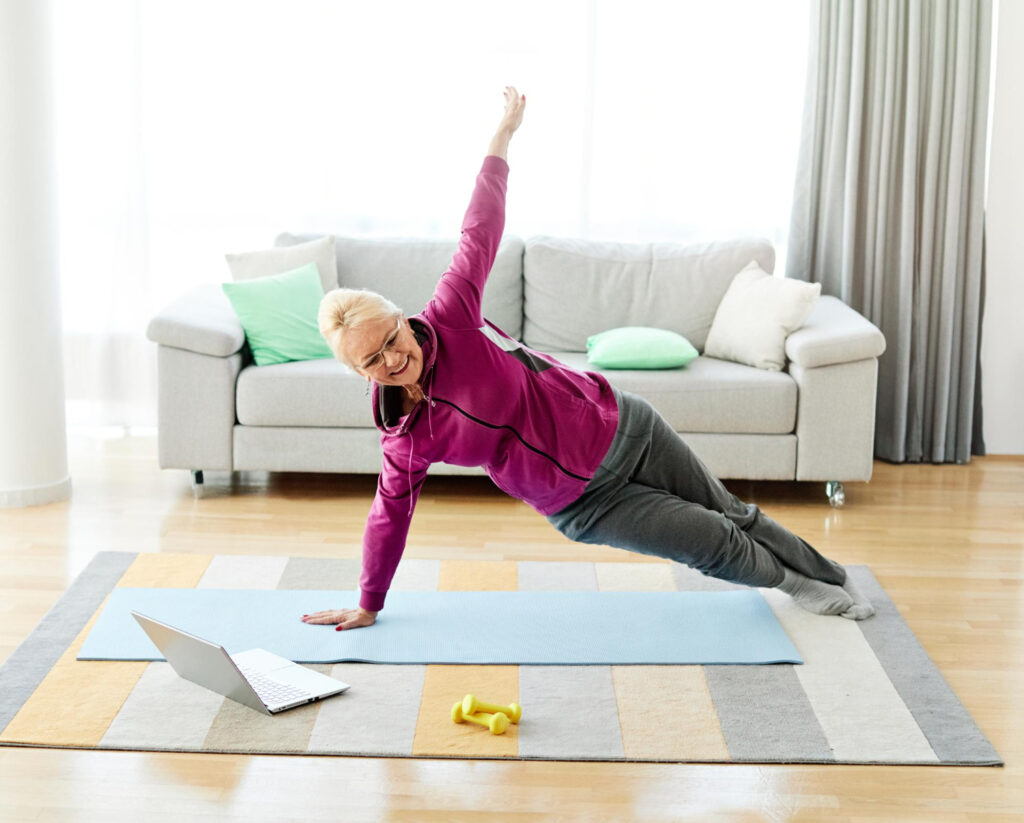
Use a resistance band to pull towards your stomach, the ‘swallow’ exercise on one leg to target the lower back and glutes, and the side plank to strengthen your core.
At the weekend, opt for regular active leisure activities: walks in the park, cycling or swimming.
When to consult a doctor before home workouts
Home workouts require a high degree of personal responsibility, as there is no trainer or healthcare professional on hand.
Be sure to consult a doctor in the following situations:
- if you have a diagnosed heart or vascular condition, or blood pressure readings above 140 over 90;
- the onset of pressing chest pain, shortness of breath or blurred vision whilst exercising;
- a history of spinal injuries, herniated discs with radicular syndrome or osteoarthritis of the major joints;
- pregnancy or the first two months after giving birth.
A specialist will help you adjust your range of motion and advise you on a safe heart rate range.
FAQ Answers to frequently asked questions
Is it possible to strengthen your muscles without buying any equipment?
Yes. Your own body weight provides sufficient resistance to stimulate muscle fibres. Slowing down the pace and varying the angles of inclination allow you to build strength without going to the gym.
Do home workouts help with weight loss?
Yes. Physical activity at home increases energy expenditure. However, the main prerequisite for weight loss remains an overall calorie deficit, where a person burns more energy than they consume through food.
What is the minimum equipment you should buy for home use?
A set of inexpensive rubber resistance bands of varying resistance levels and a pull-up bar fully meet the needs of the back and arm muscles, which are difficult to target without external equipment.
How many times a week should you exercise at home?
The World Health Organisation recommends devoting at least two days a week to strength training, supplementing this with daily walking or other aerobic activity.
Which is better for your health: gym machines or home exercises?
They are equally beneficial for general health. The body responds equally well to any form of adequate exercise. The key factors are consistency and gradually increasing the difficulty.
What should you do if you can’t do push-ups off the floor yet?
Start by doing wall push-ups, gradually moving on to using a table or the edge of a sofa for support. As your ligaments and muscles get stronger, lower your point of support closer to the floor.
About The Author