Safety in Strength Training and on Exercise Machines
Strength training with dumbbells, barbells and on pulley machines is a proven way to strengthen bones, ligaments and the cardiovascular system. The World Health Organisation and the American College of Sports Medicine recommend that every adult should do strength training at least twice a week. However, the benefits of weight training depend directly on adherence to basic technical standards. Metal equipment is subject to the strict laws of physics and mechanics, so any carelessness can result in sprained ligaments, joint damage or serious injury.
In sports traumatology, it has been proven that weights themselves do not pose a threat to health. The danger arises when a person disrupts the biomechanics of movement, ignores safety locks on exercise machines or overestimates their body’s physical capabilities.
The physiology of strength training and hidden risks
Injuries in strength sports are rarely accidental. Most injuries are caused by two adverse factors: exceeding the strength limit of connective tissue and losing control over the trajectory of the weight.
Mechanical stress and the vulnerability of ligaments
The muscle fibres of an adult have a well-developed capillary network and adapt quickly to increasing loads. Tendons and ligamentous structures consist of dense collagen and receive several times less blood supply.
If a person pushes beyond their working weight on the barbell, the muscles may be able to cope with the movement, but the ligaments are subjected to immense tensile stress. The shoulder and knee joints, as well as the intervertebral discs of the lumbar spine, are particularly vulnerable. If the weight is suddenly dropped or the joint’s axis is disrupted, the ligament does not have time to absorb the pressure, leading to micro-tears or a complete tear of the tendon.
Breathing and vascular crisis
A common mistake made by beginners is holding their breath for too long whilst lifting heavy weights. In physiology, this phenomenon is known as the Valsalva manoeuvre. When straining with the glottis closed, intra-abdominal and intrathoracic pressure rise sharply.
On the one hand, this stabilises the lumbar spine when lifting maximum weights. On the other hand, the sudden surge in pressure compresses the large hollow veins and disrupts the return of venous blood to the heart. As a result, a person’s minute volume of blood circulation may drop sharply, causing blurred vision, dizziness and sudden loss of consciousness right under the barbell.
Scientifically proven laws of mechanics and observational data
In sports science, it is important to strictly distinguish between proven laws of biomechanics and conclusions drawn from statistical observations in gyms.
Hard facts of biomechanics
Laboratory studies confirm several basic principles:
- The use of metal spring clips at the ends of the barbell bar prevents the weight plates from slipping off when the body inevitably tilts. The loss of a weight plate on one side of the bar creates an explosive, asymmetrical load on the spine and guarantees that the barbell will tip over.
- Locking the seat height on a block-style machine ensures that the axis of rotation of the human joint coincides with the axis of rotation of the mechanical block. If the axes do not coincide, destructive forces of friction and shear act on the cartilaginous surfaces of the joint.
- The presence of mechanical safety stops in the power rack completely prevents the chest and neck from being crushed by a heavy barbell should the muscles fail during the bench press or squats.
Conclusions from epidemiological observations
Statistical reports from sports clinics link the nature of injuries to the experience of those training; however, scientists note that these relationships are multifactorial.
Epidemiologists note that beginners are more likely to suffer finger injuries and foot bruises due to dumbbells falling onto the floor or an incorrect grip on the weight plates on the racks. Experienced athletes, by contrast, are more likely to suffer from chronic tendinitis and overuse injuries to the shoulder girdle. However, researchers point out that, in experienced athletes, the frequency of injuries is heavily influenced by factors such as sleep deprivation, work-related stress and chronic pre-existing injuries, rather than exercise technique alone.
A similar pattern emerges when analysing footwear. Observations show a consistent link between the use of trainers with soft running soles and ankle roll-ins during squats. The air-cushioned sole deforms under weight, creating an unstable base for the foot’s joints.
Rules for using different types of equipment
Each piece of training equipment has unique design features that require adherence to specific safety rules.
- Pull-up bars and cable stations. Always check the integrity of the plastic sheathing on the steel cable. If there are any visible metal burrs or kinks in the cable, do not use the equipment. Ensure that the metal weight-selection pin has been inserted into the plate as far as it will go and has clicked into place with the magnetic catch. Never touch the moving rollers or the joints of the weight stack with your fingers whilst the equipment is in motion.
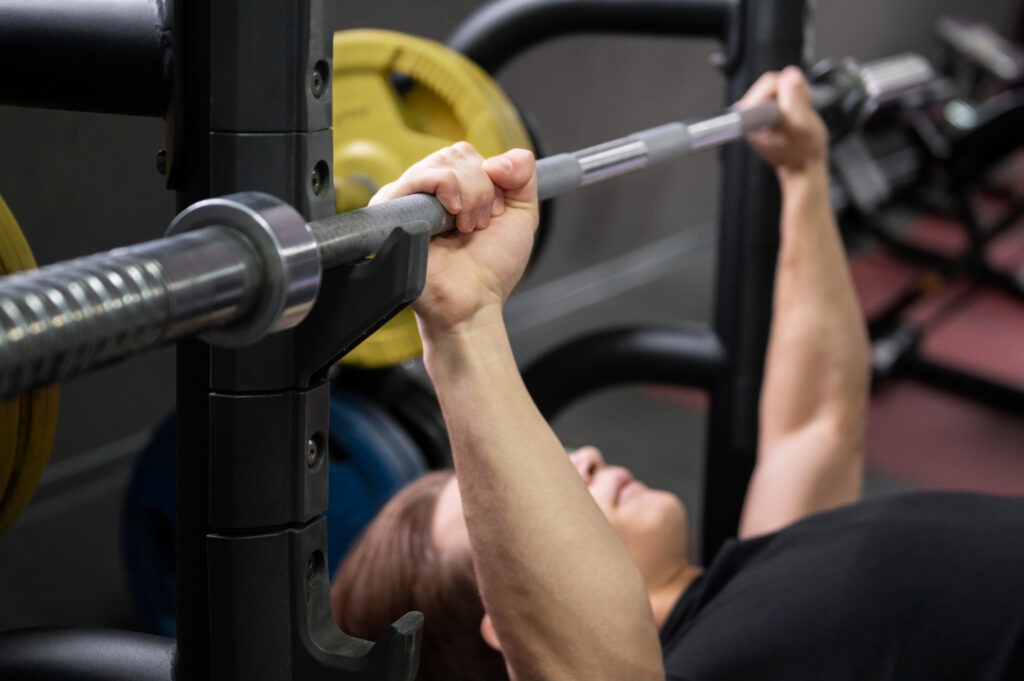
- Free-standing barbells and bench press racks. Adjust the height of the barbell hooks so that you do not have to stand on your tiptoes to remove the bar. When working with submaximal weights, never use an open or monkey grip, where the thumb is on the same side as the other fingers. The bar slips out of an open grip instantly, leaving you no chance of holding onto the weight.
- Dumbbells and kettlebells. Wipe sweat from your palms before starting a set, or use dry gymnastic chalk. When finishing a set with heavy dumbbells on a bench, lower the weights first onto your bent thighs, then sit down smoothly, avoiding throwing the weights onto the floor with your shoulders hyperextended.
- Rubber loops and resistance bands. Before each stretch, inspect the latex for whitish micro-cracks and tears. Secure the band only to smooth, round posts with no sharp edges. Never stretch the rubber loop towards your own eyes or face.
When you must stop your workout immediately
A moderate burning sensation in the muscles during the final repetitions of a set is a natural sign of the build-up of hydrogen ions and lactic acid. This is a normal physiological response to exercise.
However, there are a number of warning signs under which continuing the exercise is strictly prohibited.
Stop the set immediately and consult the instructor on duty or a doctor in the following cases:
- the onset of a sharp, shooting pain in the spine, radiating like an electric shock into the buttock or leg;
- the onset of a pressing pain, burning sensation or feeling of heaviness behind the breastbone;
- a sudden clicking sound in a joint, accompanied by acute localised pain and restricted movement;
- a growing sensation of numbness in the fingers or weakness in the limbs;
- a bout of nausea, a sudden darkening of vision and ringing in the ears whilst lifting a weight;
- visible swelling of the joint or the appearance of subcutaneous haemorrhage at the site where the tendon attaches.
Ignoring these signs and attempting to complete a set despite severe pain can turn a minor, reversible injury into a serious anatomical defect requiring lengthy surgical intervention.
Personal responsibility and a culture of safety in the gym
Safety in the gym is built on respect for one’s own body and for those around you. The vast majority of everyday injuries in fitness centres occur not whilst performing complex exercises, but simply from tripping over equipment left lying about.
After completing an exercise, always dismantle the barbell and return the weights to the designated storage racks. Remove the weights from the bar one at a time on each side to prevent the empty end of the barbell from tipping over dangerously.
Do not train in the gym wearing beach flip-flops, socks or outdoor shoes. Sturdy sports shoes with non-slip soles protect your toes from accidental impacts and maintain the correct arch of your foot.
Strength training only builds strength, bone density and vitality when the athlete respects the laws of physics and modulates the load without blind enthusiasm.
FAQ Answers to frequently asked questions
Which is safer for a beginner: cable machines or the barbell?
Machine-based exercises are safer in the early stages, as they provide a fixed range of motion and prevent the weight from falling onto the torso. Free weights engage numerous small stabilising muscles, so you should move on to them only after mastering basic movement coordination.
Why are bar locks needed for light weights?
Even a light barbell tilts slightly to one side when the muscles tire. Without locks, the discs immediately start to slide down the bar, disrupting the centre of gravity and leading to a sudden dislocation of the shoulder joint or the barbell falling.
Does a weightlifting belt help protect the lower back from all injuries?
No. A leather weightlifting belt merely helps to create higher intra-abdominal pressure when lifting maximum weights. It does not correct serious technical errors, nor does it replace the work of your own deep abdominal and back muscles.
Is it essential to ask someone to spot you when doing the bench press?
Yes. When performing the bench press above the chest, assistance from a trained partner or the use of safety stops in a power rack is an essential safety requirement, regardless of the athlete’s experience.
Is it allowed to train barefoot in the gym?
In most fitness centres, this is prohibited by health and safety regulations. Bare feet slide easily on smooth rubber flooring, and the toes remain completely unprotected against falls, even from small dumbbells.
How should you breathe when lifting dumbbells or a barbell?
The basic rule is: exhale forcefully at the moment of maximum muscular effort and as you lift the weight, and inhale calmly as you lower the weight smoothly back to the starting position.
About The Author