Why does the state of your surroundings affect your inner state?
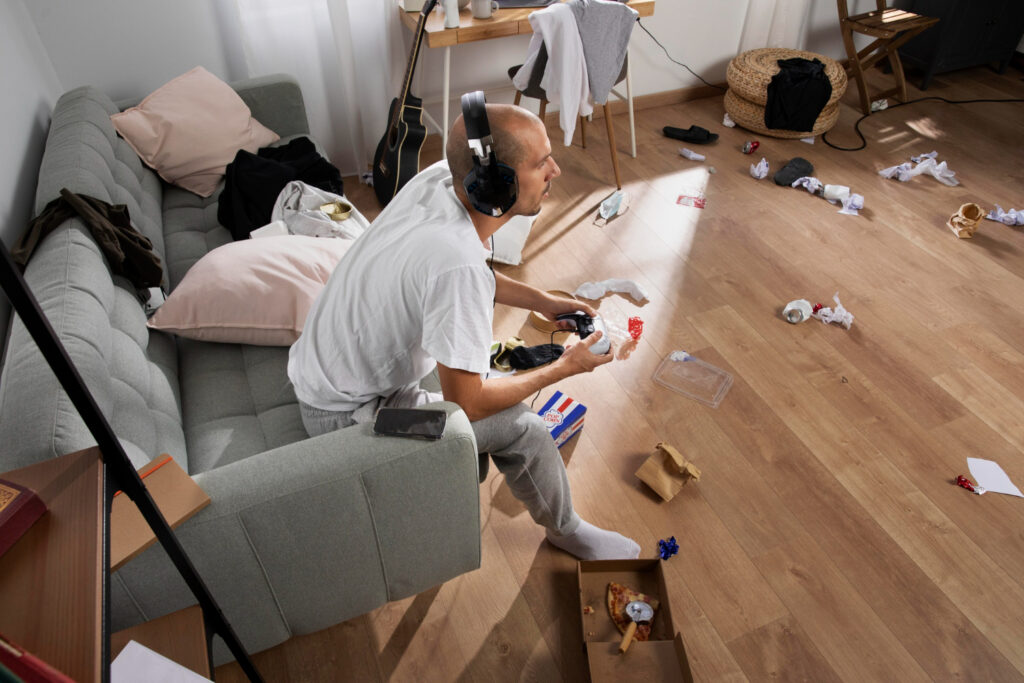
Have you ever found yourself staring blankly at a single spot in the middle of the working day, even though the deadline is fast approaching? It’s not laziness. It’s a state where your brain ‘freezes up’, overwhelmed by an excess of minor distractions. Chaos in your flat or on your desk isn’t just an aesthetic problem; it’s a constant drain on your mental energy. Every extra item in your field of vision demands a micro-decision from your brain: ‘What should I do with this? Where should I put it?’. As a result, your daily quota for decision-making is exhausted before you’ve even got round to the really important tasks. These days, tidiness isn’t about ‘good manners’, but about mental hygiene and conserving your mental energy.
How the environment affects brain function
Our brains are evolutionarily tuned to seek patterns and structures. When we find ourselves in a space where objects are scattered chaotically, the visual cortex starts working overtime. Neurobiologists at Princeton have discovered that an abundance of visual stimuli (old cups, piles of papers, open tabs) creates an effect known as ‘cognitive competition’. This is a state where objects are literally fighting for your attention, suppressing your ability to analyse deeply.
Cause → Effect → Practice The brain constantly expends energy filtering out unnecessary signals from the external environment. If there are too many of these signals, the ‘filters’ become overloaded. The result is that you become irritable, make silly mistakes and cannot concentrate even on a simple text.
Practical conclusion: Use the ‘clear horizon’ principle. Before tackling a task that requires high intellectual effort, remove everything unrelated to the task from your field of vision. An empty desk is not emptiness, but free working memory for your brain.
Clutter and stress levels
For our nervous system, clutter is a signal of incompleteness. The brain perceives clutter as a to-do list that is ‘hanging in the air’. As long as you see a mountain of unsorted items, your amygdala (the brain’s anxiety centre) sends a danger signal: ‘Resources are being wasted, the environment is unstable’.
UCLA research has shown that in cluttered homes, people’s (especially women’s) cortisol levels do not drop even by the evening. This is a state of ‘chronic readiness for action’, which prevents the body from initiating recovery processes.
- A common mistake: Thinking that if you’ve stopped noticing the mess, it has stopped affecting you. In reality, your subconscious continues to scan the space 24/7, using up to 30% of your energy in the process.
- Real-life scenario: It’s evening, you’re trying to relax whilst watching a film, but your gaze is drawn to a dusty shelf or a box in the corner. You don’t get up to tidy it away, but your evening is already ruined: your brain has switched from ‘recovery’ mode to ‘passive guilt’ mode.
A sense of control and psychological stability
Psychologists often link clutter to the phenomenon of ‘learned helplessness’. If a person cannot tidy their own bag or desk, their brain draws a sweeping conclusion: ‘I am not in control of my life’. This is a direct path to depression and chronic anxiety.
How it works in reality: Tidying up is the quickest way to get a legal dose of dopamine. You take chaos and turn it into structure. At that moment, the brain receives confirmation: ‘I am taking action, I am influencing the world, I am safe’. This is precisely why, after tidying up, we feel a surge of energy rather than tiredness. It is not physical vigour, but mental relief.
Impact on concentration and productivity
There is a concept known as the ‘switching cost’. Every time your gaze shifts from the monitor to scattered items, your brain makes a micro-switch. It takes between 5 and 20 minutes to refocus your attention back to where it was. If you have ten such distractions in an hour, you’re not actually working; you’re just letting your neurons ‘idle’.
- Real-life example: You’re working on a report, but out of the corner of your eye you see a mountain of dirty washing-up. Your brain automatically forms a chain of thought: ‘Dishes – need washing – no time – I’m a bad housekeeper’. That’s it, your focus on the report is lost, and your energy has been spent on suppressing feelings of guilt.
- Conclusion: Tidiness is armour for your attention. The fewer objects around you, the less energy your brain expends on every minute of work.
Tidiness and emotional state
The space around us is a mirror of our inner state. Psychologists note that prolonged untidiness is often not the cause, but a symptom of burnout. But the reverse is also true: by creating an external structure, we help our mind to gather itself.
Where to save
Don’t try to be a perfectionist. Perfect order is also stressful. ‘Functional sufficiency’ is what matters. If you know where your passport is and don’t trip over things in the dark – that’s enough for your brain to feel safe. The main thing is to remove ‘visual distractions’ (bright packaging, piles of paper, random clutter) that force the mind to remain constantly on alert.
Impact on sleep and physical health
The bedroom is the only place where the brain should be in ‘zero activity’ mode. Any item associated with work or everyday problems (laptop, receipts, ironing board) triggers cognitive processes.
- Consequence: You fall asleep, but your brain continues to ‘mull over’ the day’s tasks. Sleep becomes fragmented, and the deep sleep phase is reduced.
- Chain reaction: Poor sleep → high blood sugar → cravings for overeating → weakened immunity. Clearing the bedroom of clutter is not a design choice, but a preventive measure against psychosomatic illnesses. A clear space around the bed signals to the nervous system that there are no external threats and that it can completely switch off.
Why tidying really does improve your mood
The therapeutic effect of tidying up can be explained by three factors:
- The dopamine loop: Every unnecessary item thrown away or surface cleared gives an instant sense of completion. This is ‘instant fuel’ for your mood.
- Sensory deprivation (in a good way): Reducing the number of objects around you gives your eyes and ears a rest. Your inner dialogue quietens down.
- Physical grounding: In the age of digital work, we lack a tangible result. By wiping a table or arranging books, you return to reality, which is very helpful for panic attacks and severe stress.
Tidiness is not an obligation to guests or society. It is your personal right to peace of mind and clear thinking. In a world that constantly demands our attention through smartphone screens, home must remain a place where the brain does not need to analyse anything.
By spending 15 minutes a day organising your space, you’re buying yourself a few hours of quality concentration and deep sleep. As experts, we insist: treat a tidy desk as medicine. It’s the cheapest and quickest way to lower your cortisol levels and regain control of your own life.
FAQ: Frequently Asked Questions
Is creative clutter considered harmful to health?
Creative clutter is only useful during the idea-generation phase, when the brain needs unexpected associations. But during the project implementation phase, it becomes a barrier. Geniuses create in chaos, but they see things through to the end in order.
Why does it physically hurt me to throw things away, even if I don’t need them?
This is the ‘endowment effect’ at work. The brain perceives personal belongings as part of its own body. For the subconscious, losing an old T-shirt is equivalent to losing a resource. The ‘quarantine’ method helps here: put things in a box for a month. If you haven’t thought of them again – throw them away.
How does tidiness affect family relationships?
Clutter is a breeding ground for passive aggression. When one family member is forced to constantly deal with someone else’s mess, their stress levels rise, which inevitably leads to conflict. Tidiness reduces the level of everyday irritation.
Does minimalism help you become smarter?
Minimalism doesn’t increase your IQ, but it removes ‘distractions’. In an empty room, you don’t become smarter; you simply use your intellect to its full potential, without wasting it on processing visual noise.
Can tidying up replace a visit to a psychologist?
For mild anxiety – yes. In cases of clinical depression, tidying up may be physically impossible. But as a form of supportive therapy, tidying up is one of the most effective self-help tools.
About The Author